


QUICK SUMMARY
Mama Z’s DIY sea salt spray adds texture, volume, and definition to naturally wavy or curly hair without aerosol propellants, synthetic fragrance, or a long list of styling ingredients.
Sea salt creates the tousled effect, while aloe vera and fractionated coconut oil help balance some of its drying action. Vitamin E and optional lavender or grapefruit essential oil add conditioning and a fresh aroma.
This spray works best as a light styling product—not as a treatment for dandruff, hair loss, or scalp disease. Because it contains water and fresh aloe, prepare small batches, keep the bottle clean, and refrigerate it unless you add a cosmetic preservative designed for water-based products.
Curly-haired girls, rejoice!
My DIY sea salt spray highlights your natural texture, adds touchable volume, and helps create relaxed, beach-inspired waves without spending half the morning styling your hair.
Whether you want an easy hairstyle for a day outdoors, need to revive second-day curls, or simply want to give flat hair more movement, this spray belongs in your natural beauty routine.
The sea salt creates texture while aloe vera, fractionated coconut oil, and vitamin E help keep the finished style from feeling overly dry. Optional essential oils add a fresh aroma without relying on synthetic fragrance.
Here’s the thing: sea salt is a texturizer, not a deep conditioner.
Too much salt can leave some hair types dry, tangled, or brittle. The secret is to use a light mist, customize the oils for your hair, and alternate this spray with nourishing hair care.
God created every head of hair with its own texture, density, curl pattern, and personality. This simple recipe helps you work with what you were given instead of fighting it.
Table of Contents
- Why Choose Natural Hair-Care Products?
- A Special Note From Mama Z
- How Sea Salt Spray Works
- Ways to Use a Curl-Enhancing Spray
- DIY Sea Salt Spray Ingredients
- How to Make DIY Sea Salt Spray
- How to Customize the Recipe
- Storage and Preservation
- Sea Salt Spray Safety
- DIY Sea Salt Spray FAQs
- Final Thoughts
- Resources

Why Choose Natural Hair-Care Products?
Hair-care products do more than sit on the ends of your hair.
Depending on how you apply them, they may come into contact with:
- Your scalp
- Your forehead, neck, and ears
- Your hands
- Your pillowcase
- Your clothing
- The air you breathe when using sprays
- Wastewater when the product is rinsed away
The skin acts as a protective barrier, so it is inaccurate to say that every ingredient placed on the scalp immediately enters the bloodstream. Absorption depends on the chemical, concentration, condition of the skin, contact time, and formulation.
Still, repeated exposure matters—especially for people with sensitive skin, eczema, fragrance reactions, asthma, or scalp irritation.
Some conventional styling products contain:
- Synthetic fragrance
- Drying alcohols
- Aerosol propellants
- Silicones that can build up on some hair types
- Strong preservatives
- Colorants
- Ingredients that trigger contact dermatitis in sensitive users
Not every conventional product is toxic, and natural ingredients can also cause irritation or allergy.
The advantage of making your own spray is control. You know exactly what goes into the bottle, and you can adjust the formula according to your hair’s response.
Can Hair Products Cause Breakouts?
Yes, certain styling products may contribute to breakouts around the hairline, forehead, neck, or back.
This is sometimes called pomade acne. Heavy oils, waxes, occlusive styling products, and fragranced ingredients may transfer from the hair to the skin or pillowcase.
To reduce the risk:
- Apply styling products primarily to the lengths of the hair.
- Avoid saturating the forehead or hairline.
- Wash pillowcases regularly.
- Keep hair away from the face while sleeping when practical.
- Stop using products that repeatedly cause itching or breakouts.
A Special Note From Mama Z
As with all our DIY recipes, I encourage you to find what works for your specific needs.
God created each of us uniquely, and our hair reflects that beautiful variety.
A formula that gives one woman soft waves may leave another woman’s hair stiff or oily. Hair response depends on:
- Curl pattern
- Hair density
- Porosity
- Strand thickness
- Color or chemical treatment
- Climate and humidity
- Scalp condition
Begin with a small amount. Take notes. Adjust one ingredient at a time.
That is the beauty of homemade body care—you are not trapped by a one-size-fits-all formula.
For Dry or High-Porosity Hair
Reduce the sea salt slightly and increase the aloe vera or fractionated coconut oil.
You can also apply a lightweight leave-in conditioner before using the spray.
For Fine or Oily Hair
Use less oil and apply the spray mostly from the mid-lengths to the ends.
Too much oil may reduce the volume you are trying to create.
For Color-Treated Hair
Use a lower concentration of salt and avoid daily application.
Salt, sunlight, chlorine, heat, and repeated washing can all contribute to dryness and color fading.
Carrier oils may coat the hair and reduce some grooming-related damage, but they should not be treated as reliable sunscreen. Wear a hat or use a tested hair product with ultraviolet protection when you will be outdoors for extended periods.
For Hair Loss
Hair loss can result from:
- Iron deficiency
- Thyroid disease
- Hormonal changes
- Postpartum shedding
- Autoimmune disease
- Scalp inflammation
- Medication effects
- Genetic pattern hair loss
- Severe illness or stress
- Tight hairstyles
Castor and jojoba oils are commonly used in scalp products, but strong human evidence that either oil independently regrows hair is limited.
Tea tree essential oil has antifungal activity and a clinical trial found that a shampoo containing 5% tea tree oil improved mild-to-moderate dandruff. That does not prove that tea tree oil stimulates hair growth. (1)
Sudden shedding, smooth bald patches, scalp scarring, or persistent thinning deserves evaluation by a dermatologist or qualified clinician.
For Dandruff or an Itchy Scalp
Dryness is only one possible cause of flaking.
Dandruff may also involve:
- Seborrheic dermatitis
- Yeast overgrowth
- Psoriasis
- Eczema
- Contact allergy
- Product buildup
Grapeseed or avocado oil may soften dry skin, but adding more oil can worsen some cases of seborrheic dermatitis.
Tea tree or lemongrass essential oil has been studied in prepared dandruff products, but effective research formulations were much stronger and more carefully formulated than an ordinary leave-in spray. Do not increase essential oils to clinical-study concentrations in a homemade mist. (1, 2)
For Extra Shine
Add a small amount of vitamin E oil or replace part of the fractionated coconut oil with jojoba.
Use a light hand. Oils reflect light and smooth the surface temporarily, but too much can make curls appear greasy or limp.
How Sea Salt Spray Works
Sea salt spray creates texture by leaving tiny salt crystals on the hair as the water evaporates.
This can:
- Increase friction between strands
- Reduce a slippery or overly soft feel
- Encourage strands to group into waves or curls
- Add temporary body and volume
- Absorb a small amount of surface oil
This is similar to the tousled texture many people notice after swimming in the ocean.
Does Sea Salt Curl Straight Hair?
Sea salt spray does not permanently change the structure of straight hair.
It works best on hair that already has:
- A natural wave
- A loose curl pattern
- Texture that appears when damp
- The ability to hold a scrunched or braided style
Straight hair may gain grit, body, and a slightly undone appearance, but it may not form defined curls without braiding, twisting, rollers, or another styling method.
Can Sea Salt Dry Out Hair?
Yes.
Salt attracts water and may leave hair feeling drier, rougher, or more tangled, particularly when:
- The formula is highly concentrated.
- It is used every day.
- The hair is bleached or chemically treated.
- The hair is already dry or high-porosity.
- It is combined with prolonged sun, wind, or chlorine exposure.
Aloe and oils help balance the feel of the spray, but they do not completely cancel salt’s drying effect.
Use only enough product to create the texture you want.
Ways to Use a Curl-Enhancing Spray
1. At the Beach or Pool
My favorite way to use this spray is after swimming.
Saltwater, chlorine, sun, and wind can all tangle or dry hair, so rinse your hair with clean water first when possible.
Then:
- Gently squeeze out excess water with a towel.
- Shake the spray bottle thoroughly.
- Mist lightly through the lengths.
- Scrunch upward with your hands.
- Allow the hair to air-dry.
When packing your beach bag with sun-protection products, water, and healthy snacks, add your curl spray for an easy post-swim style.
Important: This hair spray does not protect your scalp or hair from ultraviolet damage. Wear a broad-brimmed hat and use appropriate sun protection.
2. Everyday Heat-Free Styling
After showering:
- Blot wet hair with a microfiber towel or soft cotton shirt.
- Divide it into sections.
- Mist each section lightly.
- Scrunch toward the scalp.
- Allow it to air-dry or use a diffuser on a low setting.
Avoid brushing the curls after they begin drying because this can separate curl clumps and create frizz.
3. Refreshing Second-Day Curls
Lightly mist dry or slightly damp hair, concentrating on flattened sections.
Twist individual curls around your finger or scrunch them gently to help reactivate the pattern.
4. Braided Beach Waves
Mist damp hair lightly, divide it into one or more braids, and allow it to dry completely.
When you release the braids, separate the waves gently with your fingers.
5. Adding Texture to an Updo
Apply a light mist before creating:
- Braids
- Messy buns
- Ponytails
- Half-up styles
- Twists
The added grip may help clips and pins stay in place.
DIY Sea Salt Spray Ingredients
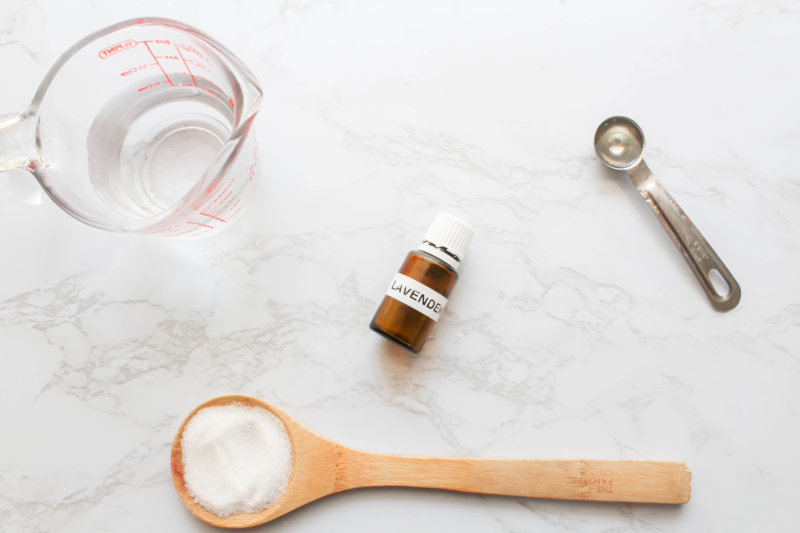
This spray uses seven simple ingredients to create texture while maintaining a soft, touchable finish.
Distilled or Purified Water
Water forms the base of the spray and distributes the salt, aloe, and other ingredients.
Distilled water is especially helpful for homemade cosmetics because it contains fewer minerals and microbes than untreated water.
Tap-water quality varies by location. Regulated municipal water is generally treated and monitored, so it is inaccurate to claim that all tap water causes obesity or birth defects. Local contaminants, plumbing, private wells, and water hardness can still affect water quality and product stability.
For a leave-in spray, distilled water gives you the most consistent starting point.
Fresh Frozen Aloe Vera or Aloe Vera Gel
Aloe vera is a lightweight humectant that can help hair feel softer and more hydrated.
It adds slip without the heaviness of a rich conditioner.
Evidence for aloe as a hair-growth treatment is limited. A small controlled trial found improvement in seborrheic dermatitis when an aloe-based emulsion was used, but that does not prove that plain aloe gel makes hair grow. (3)
Choose a cosmetic-grade aloe product with a clear ingredient list. Some commercial gels contain:
- Thickeners
- Preservatives
- Colorants
- Fragrance
A preserved commercial aloe gel may give the spray a longer life than fresh plant gel, but it does not necessarily preserve the entire finished mixture.
Fractionated Coconut Oil
Fractionated coconut oil remains liquid at room temperature, making it convenient for sprays and lightweight body-care formulas.
Research on ordinary coconut oil found that it reduced protein loss from damaged and undamaged hair when used before or after washing. Its lauric-acid content and molecular structure help it penetrate the hair shaft more effectively than some other oils. (4)
Fractionated coconut oil has a different fatty-acid profile from virgin coconut oil, so it should not automatically be assumed to produce identical protein-loss results.
In this recipe, its primary roles are to:
- Add softness
- Reduce a crunchy feel
- Improve shine
- Carry the essential oils
Sea Salt
Sea salt creates the spray’s texture and volume.
Fine salt dissolves more easily than coarse crystals and is less likely to clog the nozzle.
Begin with the recipe amount. Reduce it when your hair is:
- Bleached
- Very dry
- Highly porous
- Fragile
- Prone to knots
Do not add more simply because you want stronger hold. Too much may leave a white residue or make hair stiff.
Vitamin E Oil
Vitamin E oil adds shine and acts as an antioxidant for the oils in the formula.
Vitamin E is not a broad-spectrum cosmetic preservative. It may slow oxidation of oils, but it does not prevent bacteria, yeast, or mold from growing in a water-based spray.
This distinction is important for safe storage.
Grapefruit Essential Oil
Grapefruit essential oil adds a fresh, uplifting citrus aroma.
It is often described as clarifying because the aroma feels clean and the oil can help cut through an oily sensory feel. Human evidence that it removes hair buildup or treats scalp disease is limited.
Is Grapefruit Essential Oil Phototoxic?
Cold-pressed grapefruit oil can be phototoxic at sufficiently high skin concentrations because it may contain furanocoumarins.
The topical maximum commonly recommended to avoid phototoxicity is approximately 4%. The amount in this recipe should be much lower, but the scalp may receive direct sun exposure where hair is thin or parted.
For an outdoor hair product, consider:
- Using steam-distilled grapefruit oil
- Using a furanocoumarin-free grapefruit oil
- Replacing it with a non-phototoxic oil
- Wearing a hat in strong sunlight
Lavender Essential Oil
Lavender essential oil adds a soft floral aroma that blends beautifully with grapefruit.
Laboratory and animal research has explored lavender for antimicrobial and hair-growth effects. One often-cited hair-growth study was performed in mice—not humans. (5)
A human aromatherapy trial involving a combination of thyme, rosemary, lavender, and cedarwood oils found improvement in alopecia areata, but that result cannot be attributed to lavender alone or generalized to every kind of hair loss. (6)
In this spray, lavender is included primarily for aroma and scalp-friendly cosmetic use—not as a guaranteed hair-regrowth treatment.
How to Make DIY Sea Salt Spray
This recipe comes together quickly and gives curls a soft, textured finish.
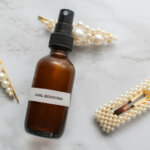
DIY Sea Salt Spray to Enhance Curly Hair
Quantity
Ingredients
- ½ cup purified OR distilled water
- 2 tablespoons fresh frozen aloe vera or aloe vera gel
- ½ tablespoon fractionated coconut oil
- ½ teaspoon sea salt OR pink Himalayan salt, ground
- 5 drops vitamin E oil
- 10 drops grapefruit essential oil
- 5 drops lavender essential oil
Supplies
Instructions
- Mix ingredients into a glass spray bottle and shake well.
- To use, divide hair into layers and mist each layer.
- Shake after a few squirts, since the oils and water will separate.
- Scrunch with your hands to create gorgeous beachy waves!
Step One: Prepare the Bottle
Wash the glass spray bottle and sprayer thoroughly with hot, soapy water.
Rinse well and allow both pieces to dry completely.
For additional sanitation, rinse the bottle with 70% isopropyl alcohol and allow it to air-dry before filling.
Step Two: Dissolve the Sea Salt
For the smoothest spray, warm part of the distilled water until it is hot but not boiling.
Stir in the sea salt until dissolved.
Allow the mixture to cool before adding aloe vera or essential oils.
Step Three: Combine the Ingredients
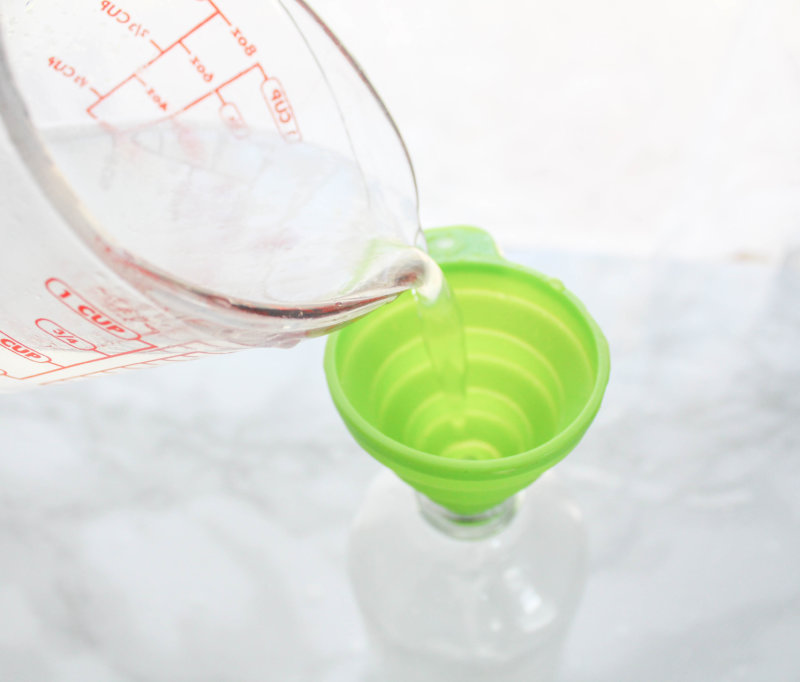
Add the distilled water, aloe vera gel, fractionated coconut oil, sea salt solution, vitamin E oil, and essential oils to the clean glass spray bottle.
Replace the sprayer and shake thoroughly.
Why Does the Spray Separate?
Oil and water do not naturally remain mixed.
The essential oils, coconut oil, and vitamin E will rise and form droplets or a separate layer. Shaking temporarily redistributes them but does not create a stable emulsion.
Shake the bottle vigorously before every application.
Step Four: Divide and Mist the Hair
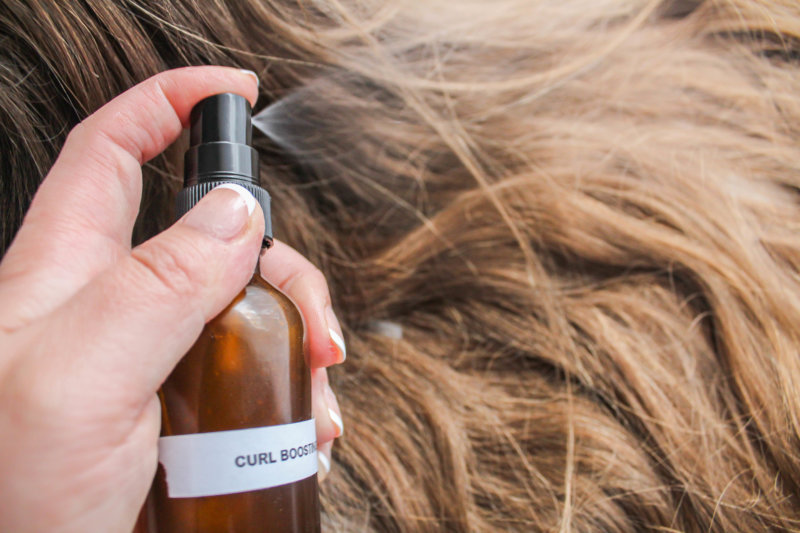
Divide damp hair into sections.
Mist each layer lightly, keeping the spray out of the eyes and avoiding an overly wet scalp.
Scrunch each section with your fingers or a soft cotton shirt.
Step Five: Dry Without Disturbing the Curls
Allow the hair to air-dry or use a diffuser on low heat and low airflow.
Once the curls form, avoid repeated touching until the hair is dry.
When necessary, gently scrunch out any stiffness with clean hands or one drop of lightweight carrier oil.
How to Customize the Recipe
For Softer Curls
Reduce the salt and add slightly more aloe.
Do not add too much carrier oil at once, or the spray may weigh the hair down.
For More Texture
Use the full amount of sea salt and apply the spray to damp rather than soaking-wet hair.
Add more product only after the first application dries.
For Fine Hair
Reduce:
- Fractionated coconut oil
- Vitamin E oil
- Aloe gel when it feels heavy
Apply mainly to the lengths.
For Thick or Coarse Hair
Increase aloe slightly or apply a leave-in conditioner before the spray.
Thick hair may tolerate more product, but salt can still accumulate.
For Dry Hair
Use the spray no more than a few times per week and follow with a moisturizing wash or mask.
Consider replacing a portion of the saltwater formula with additional aloe.
For Oily Roots
Keep oil away from the scalp and mist primarily through the mid-lengths.
Sea salt may temporarily absorb some surface oil, but it is not a substitute for scalp cleansing.
Essential-Oil Alternatives
Possible aromatic substitutions include:
- Roman chamomile
- Cedarwood
- Geranium
- Rosemary
- Tea tree
- Lemongrass
Each oil has its own maximum concentration, allergy potential, and age or pregnancy considerations.
Lemongrass is particularly concentrated and can irritate skin at higher levels. Use only a small amount in leave-in products.
Cedarwood may add a warm aroma, but there is not enough evidence to call it a dependable heat protectant. Physical heat protection depends on a tested formulation and careful temperature control.
Storage and Preservation
This is one of the most important sections in the entire recipe.
Water, aloe vera, and plant ingredients can support the growth of bacteria, yeast, and mold—even when the product looks and smells normal.
Does Vitamin E Preserve the Spray?
No.
Vitamin E is an antioxidant. It can slow rancidity in oils, but it does not provide broad-spectrum protection against microbes in a water-based product.
Essential oils are not reliable substitutes for a properly tested cosmetic preservative.
How Long Does Homemade Sea Salt Spray Last?
Without a cosmetic preservative:
- Prepare a small batch.
- Refrigerate it.
- Use it within approximately 1–2 weeks.
- Keep fingers and dirty tools away from the bottle opening.
Freezing fresh aloe before adding it does not make the finished water-based spray shelf-stable.
For Room-Temperature Storage
A room-temperature water-based product requires a broad-spectrum cosmetic preservative compatible with:
- The formula’s pH
- The percentage of water
- The other ingredients
- The manufacturer’s recommended usage rate
A preservative must be added according to supplier instructions. Commercial shelf life should be confirmed through microbial challenge testing, not guesswork.
When to Discard the Spray
Throw it away immediately if you notice:
- Mold
- A sour or fermented odor
- Unexpected cloudiness
- Gas or pressure in the bottle
- A dramatic color change
- A slimy texture
- New scalp irritation
Do not try to rescue a contaminated product by adding more essential oil.
Sea Salt Spray Safety
Protect the Eyes
Salt and essential oils can sting intensely.
Spray into your hands first when applying near the face, temples, or bangs.
Patch Test the Finished Product
Apply a small amount behind the ear or along the inner arm.
Wait 24 hours and watch for:
- Redness
- Itching
- Burning
- Swelling
- Rash
Stop using the spray if irritation develops.
Avoid Broken or Inflamed Skin
Do not apply it to:
- Open sores
- Fresh scratches
- Severely inflamed eczema
- Sunburned scalp
- Areas irritated by bleaching or chemical treatments
Use Caution With Essential Oils
Essential oils may cause contact dermatitis or sensitization, especially with repeated leave-in exposure.
Do not increase the concentration simply because you want a stronger fragrance.
Children
For children, consider making the recipe without essential oils.
Keep the bottle where young children cannot spray it into their eyes or mouth.
Pregnancy and Breastfeeding
A low-concentration topical hair product is different from heavy therapeutic use, but essential-oil choices still matter.
Confirm that each selected oil is appropriate for your stage of pregnancy, medical history, and infant contact.
Pets
Do not spray the product directly on pets.
Avoid misting it into the air around birds or animals with respiratory sensitivity, and prevent pets from licking freshly coated hair.
DIY Sea Salt Spray FAQs
What does sea salt spray do to hair?
It adds grip, texture, temporary volume, and definition by leaving a fine salt residue on the strands as the water evaporates.
Does sea salt spray make hair curly?
It enhances an existing wave or curl pattern but does not permanently turn naturally straight hair curly.
Can I use sea salt spray every day?
Daily use may dry out certain hair types. Begin with a few applications per week and adjust based on texture, breakage, and moisture.
Is sea salt spray good for curly hair?
It can define curls and add volume, but naturally dry, color-treated, or high-porosity curls may need less salt and more conditioning.
Does sea salt spray damage hair?
Occasional light use is unlikely to damage healthy hair, but concentrated or frequent application may increase dryness, tangling, friction, and breakage.
Should I apply sea salt spray to wet or dry hair?
Apply it to damp hair for overall curl formation or to dry hair for targeted texture and second-day refreshing.
How much sea salt spray should I use?
Begin with two or three light sprays per section. Add more only after seeing how the hair dries.
Why is my hair crunchy after using sea salt spray?
You may have used too much salt or product. Reduce the amount, dilute the spray, or scrunch the dried hair gently with a tiny amount of carrier oil.
Why does my sea salt spray separate?
The formula contains water and oils without an emulsifier. Shake it vigorously before every use.
Do essential oils dissolve in the spray?
No. They dissolve in the carrier oils but not in water. Shaking redistributes them temporarily.
Can I use regular table salt?
You can, but fine sea salt is usually preferred. Table salt may contain iodine or anti-caking agents and can create a different feel.
Can I use Epsom salt?
Epsom salt is magnesium sulfate rather than sodium chloride. It creates a different texture and should not automatically be substituted in the same amount.
Can I leave out the essential oils?
Yes. The essential oils are optional and are not required for curl definition.
Can I leave out the coconut oil?
Yes. People with very fine or oily hair may prefer an oil-free or lower-oil version. The spray may feel drier without it.
Does coconut oil protect hair?
Research on ordinary coconut oil shows that it can reduce hair protein loss. Fractionated coconut oil differs in composition, so the same level of benefit cannot be assumed. (4)
Does this spray protect hair from heat?
No. It is not a tested heat-protectant product. Keep styling tools at conservative temperatures or apply a properly formulated heat protectant.
Does this spray protect hair from the sun?
No. Carrier oils should not be treated as dependable ultraviolet protection. Wear a hat or use a tested UV-protective hair product.
Can sea salt spray treat dandruff?
No. Salt may actually irritate a dry or inflamed scalp. Persistent dandruff may require an antifungal shampoo or dermatological evaluation.
Can lavender oil regrow hair?
Lavender has shown hair-growth activity in animal research and was included in one human multi-oil trial for alopecia areata. Evidence does not prove that lavender alone regrows hair in every form of hair loss.
Is grapefruit essential oil safe in sunlight?
Cold-pressed grapefruit oil may be phototoxic at higher topical concentrations. Keep the finished concentration low, consider distilled or furanocoumarin-free grapefruit, and protect exposed scalp from strong sunlight.
How long does homemade sea salt spray last?
Without a cosmetic preservative, refrigerate it and use it within approximately 1–2 weeks. Discard it sooner if its appearance, odor, or texture changes.
Can vitamin E preserve homemade hair spray?
No. Vitamin E slows oxidation of oils but does not prevent bacteria, yeast, or mold in a water-based product.
Can I make a larger batch?
It is safer to prepare small amounts unless you understand cosmetic preservation and use a compatible broad-spectrum preservative.
Final Thoughts on DIY Sea Salt Spray
This DIY sea salt spray proves that an effective styling product does not need a long ingredient list or overpowering synthetic fragrance.
Sea salt adds texture. Aloe helps support softness. Fractionated coconut oil and vitamin E add shine and slip. Lavender and grapefruit create a bright, fresh aroma that turns an ordinary morning routine into a simple act of self-care.
But remember: more is not always better.
Too much salt can dry the hair. Too much oil can flatten curls. Too many essential oils can irritate the scalp. And a water-based DIY needs careful storage because natural does not mean microbe-proof.
Start with a light mist. Pay attention to how your hair responds. Reduce the salt for fragile curls, reduce the oil for fine hair, and leave out the essential oils when fragrance is not a good fit.
Most importantly, work with the texture God gave you.
Your hair does not need to look like anyone else’s to be beautiful. Waves, coils, curls, and straight strands all reflect the wonderful variety woven into creation.
Shake the bottle, scrunch gently, and enjoy an easy style that lets your natural texture shine.


- Satchell AC, Saurajen A, Bell C, Barnetson RS. Treatment of Dandruff With 5% Tea Tree Oil Shampoo. Journal of the American Academy of Dermatology. 2002. https://pubmed.ncbi.nlm.nih.gov/12451368/
- Chaisripipat W, Lourith N, Kanlayavattanakul M. Anti-Dandruff Hair Tonic Containing Lemongrass Oil. Journal of Cosmetic Dermatology. 2015. https://pubmed.ncbi.nlm.nih.gov/26566122/
- Vardy DA, Cohen AD, Tchetov T, Medvedovsky E, Biton A. A Double-Blind, Placebo-Controlled Trial of an Aloe Vera Emulsion in the Treatment of Seborrheic Dermatitis. Journal of Dermatological Treatment. 1999. https://pubmed.ncbi.nlm.nih.gov/10459113/
- Rele AS, Mohile RB. Effect of Mineral Oil, Sunflower Oil, and Coconut Oil on Prevention of Hair Damage. Journal of Cosmetic Science. 2003. https://pubmed.ncbi.nlm.nih.gov/12715094/
- Lee BH, Lee JS, Kim YC. Hair Growth-Promoting Effects of Lavender Oil in C57BL/6 Mice. Toxicological Research. 2016. https://pmc.ncbi.nlm.nih.gov/articles/PMC4843973/
- Hay IC, Jamieson M, Ormerod AD. Randomized Trial of Aromatherapy: Successful Treatment for Alopecia Areata. Archives of Dermatology. 1998. https://pubmed.ncbi.nlm.nih.gov/9828867/
- Kaushik V, et al. Benefit of Coconut-Based Hair Oil via Hair Porosity Quantification. International Journal of Cosmetic Science. 2022. https://pubmed.ncbi.nlm.nih.gov/35377477/
- Dinkins J, et al. Hair Oils: A Narrative Review of Their Use to Treat Androgenetic Alopecia. 2023. https://pubmed.ncbi.nlm.nih.gov/37017321/
- Tisserand Institute. Phototoxicity: Essential Oils, Sun and Safety. https://tisserandinstitute.org/phototoxicity-essential-oils-sun-and-safety/
- Tisserand Institute. Essential Oil Dilution Chart. https://tisserandinstitute.org/essential-oil-dilution-chart/


