QUICK SUMMARY
This creamy Vegan Pumpkin Dip is one of Dr. Z’s favorite Fall treats. It combines pumpkin puree, dairy-free cream cheese, Natural Confectioners’ Sugar, and culinary cinnamon, clove, and ginger essential oils for a simple make-ahead dessert or snack.
We make this recipe dairy-free because it works beautifully that way and gives families who limit conventional dairy an easy option. Our preference is still to choose high-quality dairy when we use it and simple dairy-free alternatives when they make sense.
The essential oils in this recipe are used for concentrated culinary flavor, not as medicinal doses, so use oils specifically labeled for culinary or dietary use.
One of the best parts of Fall is breaking out all the pumpkin spice recipes.
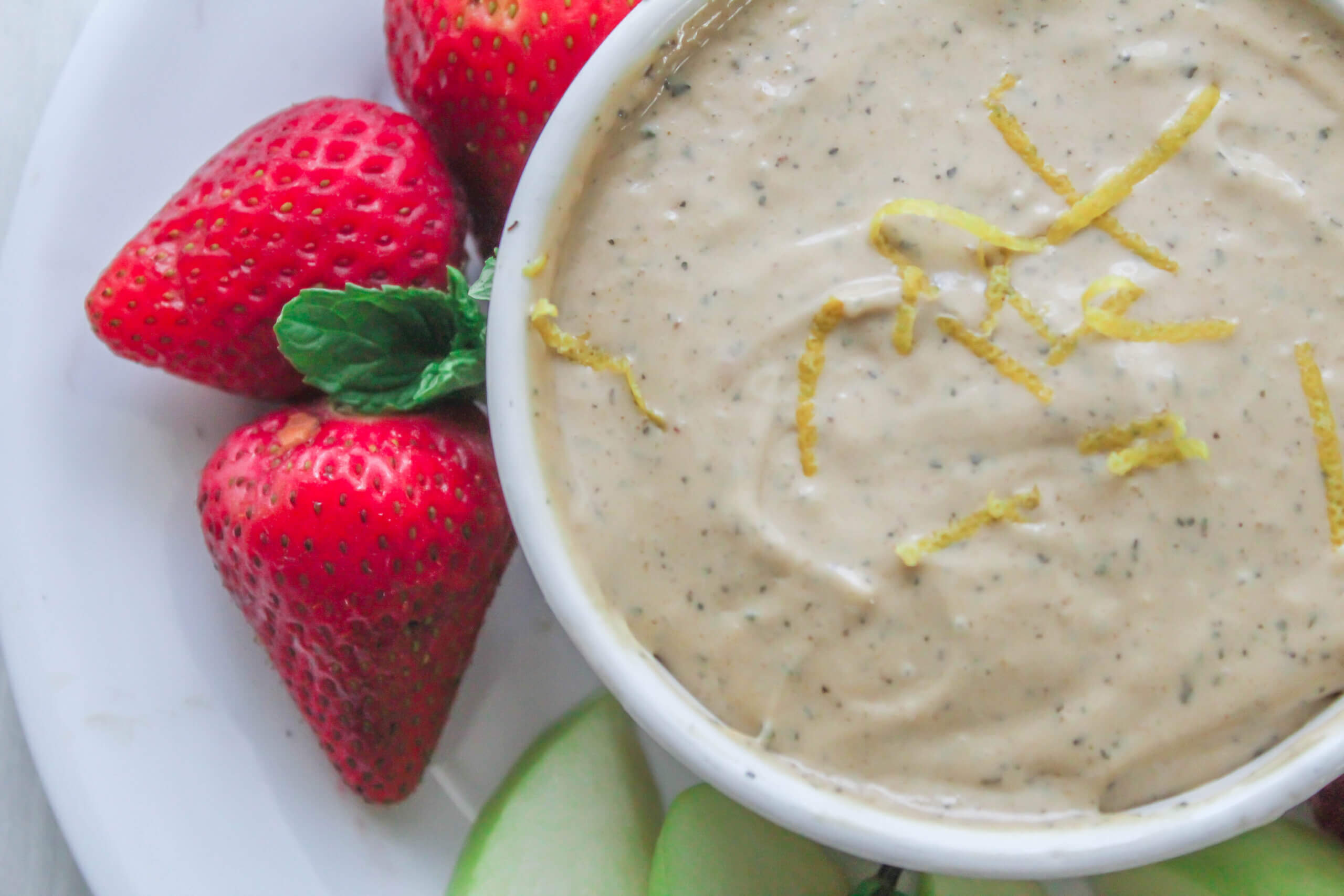
This vegan pumpkin dip just happens to be one of Dr. Z’s favorite treats! It pairs nicely with apples, gluten-free gingersnaps, and carrot sticks. You can even use it as a pancake topping.
This recipe uses essential oils to create a delicious flavor with just the right hint of spice. Every season God gives us has its own good gifts, and I know you’ll love this one as much as we do.
Table of Contents:

Why Go Dairy-Free?

If you have access to raw milk from a trusted, grass-fed cow and your family has carefully weighed the risks, I understand why you may consider yourself blessed.
Our ministry has long valued traditionally produced, grass-fed dairy and has also encouraged families to reduce or avoid conventional dairy when that works better for their health.
But a few common claims about dairy deserve a closer look.
Feed Quality Matters, But “GMO Feed” Does Not Make Milk GMO
FDA reports that more than 95% of U.S. animals raised for meat and dairy eat genetically engineered crops.
That is one reason our family cares about how animals are raised and fed.
But the DNA from genetically engineered feed does not transfer into the cow’s milk, and current evidence does not show that milk from cows eating GMO feed is nutritionally unsafe simply because of the feed source. (1)
Grass-fed and organic dairy can still differ nutritionally.
A 2024 review found that organic and pasture-based feeding patterns tend to produce milk with more omega-3 fatty acids, more conjugated linoleic acid, and a lower omega-6-to-omega-3 ratio than conventional systems. (2)
That is a much better reason to care about feed quality than saying the feed itself turns the milk into a toxin.
What About Hormones in Dairy?
It is also too broad to say most dairy cows are “pumped with hormones.”
FDA states that steroid hormone implants used to promote growth are not approved for dairy cows.
Recombinant bovine somatotropin, or rbST, is a different hormone product that has been approved to increase milk production in lactating cows. FDA considers milk from treated cows safe for human consumption. (3, 4)
If avoiding rbST is important to your family, choose organic dairy or products specifically labeled as coming from cows not treated with rbST.
Dairy and Cancer Risk: What Current Research Shows
You may have read that cheddar, cream cheese, or higher dairy intake increases breast and prostate cancer risk.
The research is more complicated than that.
A 2025 meta-analysis found that overall dairy intake was inversely associated with breast cancer risk, while associations varied by dairy type, menopausal status, age, and hormone-receptor subtype. A 2026 systematic review likewise concluded that the relationship differs by product and population rather than supporting a blanket claim that dairy causes breast cancer. (5, 6)
For prostate cancer, a 2023 meta-analysis found that higher intakes of total dairy, milk, cheese, and butter were linked with a small increase in risk, while whole milk was linked with a slightly lower risk. The researchers called for studies that adjust for PSA screening, so this does not prove that dairy causes prostate cancer (7).
That does not change the way we make this recipe, and we still love a dairy-free pumpkin dip.
We would simply rather make the case based on what we actually know.
What About Raw Milk?
We have long appreciated raw, grass-fed milk as a traditional whole food.
But the statement that pasteurization removes almost all of milk’s nutritional value is not supported by current evidence.
FDA’s review concludes that pasteurization has minimal effects on the major nutrients in milk while substantially reducing the risk of pathogens such as Salmonella, E. coli, Campylobacter, and Listeria. (8, 9)
That is an important safety distinction, especially for pregnant women, young children, older adults, and anyone with a weakened immune system.
Our family’s preference for carefully sourced food remains exactly that: a preference about sourcing, farming practices, and the kind of food system we want to support.
For convenience and versatility, we often use dairy-free ingredients in recipes like this one.
Many dairy-free products taste great and work beautifully in recipes.
For this pumpkin dip, dairy-free cream cheese gives you the smooth texture we want without dairy.
We also tend to choose almond-, cashew-, or coconut-based options instead of soy-based substitutes.
Whole soy foods have not been shown to be categorically “worse than dairy,” and research on soy foods includes several potentially beneficial health effects. (10)
Our preference here is simply to keep this recipe aligned with the way our family likes to eat.
Vegan Pumpkin Dip Ingredients

To make this pumpkin dip, you need just six ingredients, and half of them are essential oils!
Natural Confectioners’ Sugar: This recipe uses Natural Confectioners’ Sugar instead of conventional powdered sugar. It’s a mix of powdered coconut sugar and arrowroot starch.
That gives you the texture of powdered sugar without relying on ordinary confectioners’ sugar.
Organic Pumpkin Puree: This ingredient is just what it sounds like: pureed pumpkin without added sugar or pumpkin pie spices.
Many people get pureed pumpkin confused with pumpkin pie filling because it’s generally in the same aisle at the store.
If you’re wondering if you’ve grabbed the correct can, read the ingredient list. If the label lists added sugar and spices, put it back.
Pumpkin brings beautiful color, texture, beta-carotene carotenoids, potassium, and fiber to the recipe.
Dairy-Free Cream Cheese: Many grocery stores carry this product, and it creates a creamy, rich dip without dairy.
When mixed with pumpkin and fragrant essential oils, you’ll never miss the conventional version. Read the label for any food allergies in your family.
Cinnamon Essential Oil: Most pumpkin recipes are made with a pumpkin spice seasoning blend, but culinary essential oils give an incredibly concentrated burst of flavor.
A 2024 meta-analysis of randomized trials found that cinnamon supplements significantly lowered fasting blood sugar in people with type 2 diabetes (11). That research should not be treated as proof that the tiny amount of cinnamon essential oil in this dessert lowers blood sugar.
Cinnamon oil has also been studied in animal and laboratory models for antioxidant, antimicrobial, and gastrointestinal effects, but those findings do not make this dip a treatment for ulcers or metabolic disease.
Here, cinnamon essential oil is first and foremost a powerful culinary flavor.
Clove Essential Oil: You can’t have a Fall-flavored recipe without cloves!
In a 2022 laboratory study, clove essential oil and its major constituent eugenol inhibited Candida strains taken from patients’ mouths, and they worked even better when combined with standard antifungal drugs (12).
That is exciting research, but it does not mean eating this pumpkin dip eradicates Candida or treats a fungal infection in the body.
Clove is also considered a “hot” essential oil, so the established recipe amount matters. Do not add extra drops for a stronger flavor.
Ginger Essential Oil: Ginger brings that warm, spicy note that makes pumpkin recipes taste complete.
In a 2025 randomized trial of thyroid surgery patients, those who inhaled ginger essential oil had significantly less nausea and pain than patients who received routine care (13).
A 2015 study of ginger essential oil and gastric protection was conducted in animals, not people (14).
So I would not say that eating this dip treats nausea or stomach ulcers. The evidence is route-specific, and this recipe uses ginger essential oil as a culinary ingredient.
Safety Note About Essential Oils
Essential oils can be used responsibly in food when the exact oil is appropriate for culinary use and the amount is tied to the complete recipe.
Cinnamon, clove, and ginger essential oils are highly concentrated.
Use only products specifically labeled by the manufacturer as suitable for culinary or dietary use, follow the recipe exactly, and do not casually increase the number of drops.
The oils in this dip are dispersed throughout the full recipe rather than taken neat.
Can I ingest essential oils?
Do not casually ingest essential oils in water or neat (undiluted). Internal use of essential oils requires proper dilution, product quality, dosing knowledge, and safety guidance. Learn more about how to ingest essential oils here.
What to Serve With Mama Z’s Vegan Pumpkin Dip
Every great dip needs a dipper. I encourage you to try something new!
Here are some of our favorite ideas.
- Gluten-free gingersnaps
- Apples
- Carrots
- Plantain chips
- Broccoli
- Gluten-free pretzels
- Fresh berries
- Nuts
- Gluten-free graham crackers
If you need a fast dessert, make or purchase a gluten-free pie crust. Pour a batch of my Vegan Pumpkin Dip on top, and you have a fantastic no-bake pumpkin pie!
We’ve also used this as a topper for gluten-free pancakes. Place a spoonful in the middle of the pancake and roll up for a yummy crepe-style breakfast!
Make Mama Z’s Healthy Pumpkin Dip

Vegan Pumpkin Dip
Servings
Ingredients
- 2 cups Natural Confectioners’ Sugar
- 1 (15-ounce) can organic pumpkin puree
- 1 (8-ounce) container dairy-free almond-milk cream cheese OR plain cream cheese-style spread
- 4 drops cinnamon essential oil
- 2 drops clove essential oil
- 1 drop ginger essential oil
Supplies
- Blender OR food processor
- Serving bowl
Instructions
- Place the powdered coconut sugar, pumpkin puree, dairy-free cream cheese, and essential oils in a food processor bowl and process for 1 to 2 minutes, until smooth.
- Scoop into a serving bowl, cover, and refrigerate for at least 2 hours or up to overnight. Serve with carrot sticks, apple slices, and/or gluten-free gingersnaps.
Step One: Blend the Ingredients

Place the powdered coconut sugar, pumpkin puree, dairy-free cream cheese, and essential oils in a blender or food processor. Process for 1 to 2 minutes or until smooth. Scoop into a serving bowl, cover, and refrigerate for at least 2 hours. This step ensures the dip gets thick, and it lets the flavors mesh.
Step Two: Serve and Enjoy

Serve the dip with carrot sticks, apples, and/or gluten-free gingersnaps. Enjoy!
This dip is a wonderful make-ahead dessert for all your Fall gatherings. It lasts 2-3 days in the fridge if kept in an air-tight container. I guarantee you won’t be bringing home any leftovers!
Keep reading: Dairy-Free Pumpkin Pie Ice Cream Recipe: Easy Fall Dessert · Healthy Mulled Apple Cider Recipe (No Added Sugar) · Healthy Baked Apple Pancake Recipe: Gluten-Free & Dairy-Free
References
- U.S. Food and Drug Administration. “GMO Crops and Food for Animals.” https://www.fda.gov/food/agricultural-biotechnology/gmo-crops-and-food-animals
- Linehan K, Patangia DV, et al. “Production, Composition and Nutritional Properties of Organic Milk: A Critical Review.” Foods. 2024;13(4):550. https://pubmed.ncbi.nlm.nih.gov/38397527/
- U.S. Food and Drug Administration. “Steroid Hormone Implants Used for Growth in Food-Producing Animals.” https://www.fda.gov/animal-veterinary/product-safety-information/steroid-hormone-implants-used-growth-food-producing-animals
- U.S. Food and Drug Administration. “Bovine Somatotropin (bST).” https://www.fda.gov/animal-veterinary/product-safety-information/bovine-somatotropin-bst
- An S, Gunathilake M, Kim J, et al. Dairy consumption is associated with breast cancer risk: a comprehensive meta-analysis stratified by hormone receptor and menopausal status, and age. Nutrition Research. 2025. Source.
- Naowaset P. Dairy consumption and breast cancer risk: A comprehensive systematic review of current evidence. Nutrition and Health. 2026. Source.
- Zhao Z, Wu D, Gao S, et al. The association between dairy products consumption and prostate cancer risk: a systematic review and meta-analysis. British Journal of Nutrition. 2023. Source.
- U.S. Food and Drug Administration. “Raw Milk Questions & Answers.” https://www.fda.gov/food/buy-store-serve-safe-food/raw-milk-questions-answers
- U.S. Food and Drug Administration. “Raw Milk Misconceptions and the Danger of Raw Milk Consumption.” https://www.fda.gov/food/buy-store-serve-safe-food/raw-milk-misconceptions-and-danger-raw-milk-consumption
- National Center for Complementary and Integrative Health. “Soy: Usefulness and Safety.” https://www.nccih.nih.gov/health/soy
- Moridpour AH, Kavyani Z, Khosravi S, et al. The effect of cinnamon supplementation on glycemic control in patients with type 2 diabetes mellitus: An updated systematic review and dose-response meta-analysis of randomized controlled trials. Phytotherapy Research. 2024. Source.
- Biernasiuk A, Baj T, Malm A. Clove Essential Oil and Its Main Constituent, Eugenol, as Potential Natural Antifungals against Candida spp. Alone or in Combination with Other Antimycotics Due to Synergistic Interactions. Molecules. 2022. Source.
- Pashaei S, Akyüz N, Ersoy YE. The Effect of Ginger and Mint on Postoperative Nausea and Vomiting in Patients Undergoing Total Thyroidectomy. Journal of PeriAnesthesia Nursing. 2025. Source.
- Liju VB, Jeena K, Kuttan R. Gastroprotective activity of essential oils from turmeric and ginger. Animal study. Journal of Basic and Clinical Physiology and Pharmacology. 2015. Source.