QUICK SUMMARY
Homemade laundry soap is one of the easiest non-toxic laundry-room swaps you can make. This recipe combines unscented Castile soap, washing soda, OxyBoost oxygen bleach, water, and citrus essential oil to clean everyday laundry without the synthetic fragrance blends our family prefers to avoid.
Research has documented volatile organic compound (VOC) emissions from some fragranced laundry products, including hazardous air pollutants, and fragrance ingredients can be important contact allergens for sensitive people. Those studies do not prove that every commercial detergent causes cancer or illness, but they give families a good reason to read labels and reduce unnecessary fragrance exposure. (1, 2, 3, 4)
Because washing soda and oxygen bleach are alkaline cleaning agents, handle the powders carefully, avoid breathing dust, protect your eyes and skin, and keep children back from the hot mixture. (5, 6)
Have you detoxed your laundry room yet? Making your homemade laundry soap is one of the best ways to do so.
For us, “detoxing” the laundry room simply means removing unnecessary synthetic fragrance, dyes, and complicated products when a simpler option can do the job. Laundry touches our family every day through clothes, towels, sheets, blankets, and everything else we wash.
The concern is not that every conventional detergent is automatically dangerous. The concern is that some fragranced laundry products can release VOCs, some formulas contain known contact allergens, and you may not need all of those extras to get clean clothes.
The recipe I share below is a super easy and effective way to save money on getting clean clothes. It also gives you control over what goes into your laundry soap, which is one of my favorite parts of making it myself.
Table of Contents:
- Why We Avoid Conventional Laundry Fragrance & Chemicals
- Make Homemade Laundry Soap
- How Homemade Laundry Soap Ingredients Work
- Homemade Laundry Detergent Concentrate
- Homemade Laundry Detergent
- How to Make Homemade Laundry Soap
- Homemade Laundry Soap Safety & Washer Tips
- Homemade Laundry Soap FAQs
- References

Why We Avoid Conventional Laundry Fragrance & Chemicals
Every day you are exposed to a cocktail of chemicals that interact with each other in ways that are far beyond our complete understanding. We have called this the “chemical soup” for years, and the laundry room is one place where a simple swap can reduce unnecessary exposure.
That does not mean every chemical has the same risk or that everything with a long ingredient name is harmful. Dose, route, concentration, and frequency all matter. But clothing and bedding stay close to our skin for hours, and fragranced laundry products can also contribute chemicals to indoor and outdoor air.
Years ago, our friends at Annmarie Skincare helped draw attention to concerns surrounding conventional laundry products. Since then, direct research has given us a clearer picture of what is actually worth paying attention to.
Scientists Found VOCs in Fragranced Laundry Products
A University of Washington study published in 2009 analyzed six best-selling fragranced consumer products, including three laundry products and three air fresheners. Researchers identified nearly 100 VOCs. Ten of the identified compounds were regulated as toxic or hazardous under federal law, and three were classified as hazardous air pollutants. None of the identified VOCs appeared on the product labels at the time. (1)
That’s important, but it needs context. The study tested six specific products. It did not prove that every laundry detergent has the same emissions, and it did not measure whether using those products caused disease in the people who used them.
A follow-up controlled dryer-vent study, published online in 2011 and in print in 2013, looked at emissions from two residential washers and dryers. Researchers compared no laundry products, a leading fragranced liquid detergent, and the detergent plus a fragranced dryer sheet. They identified more than 25 VOCs in dryer-vent emissions, including seven hazardous air pollutants. Acetaldehyde and benzene were among the compounds classified as carcinogenic hazardous air pollutants. (2)
Again, that is an emissions study, not proof that scented detergent causes cancer. But it does confirm that laundry fragrance can become an air-quality issue, not just something that stays inside the washing machine.
EPA currently notes that VOCs come from many household sources and that some can cause short-term or long-term health effects depending on the chemical and exposure. Effects can include eye, nose, and throat irritation, headaches, nausea, and other problems, while some VOCs are known or suspected carcinogens. (4)
Fragrance Can Also Be a Skin Issue
A 2020 study reviewed ingredient lists for 65 top-selling textile-care products in the United States, including detergents, fabric softeners, dryer sheets, and stain removers. Researchers identified ten common contact allergens. Fragrances and essential oils were among the most common allergens listed across these product categories. (3)
That last point matters. I prefer essential oils to undisclosed synthetic fragrance blends, but natural does not mean that every aromatic ingredient agrees with every person. Someone with a known fragrance or essential-oil allergy may need a completely fragrance-free laundry routine.
If you want to dig deeper into specific ingredients, see our guide to chemicals in laundry detergent we prefer to avoid.
Just walk down the laundry aisle and you can be overwhelmed by scent before you even open a bottle. This, my friend, is why it’s so important to take action and make sure you’re using something with safe, simple ingredients that work for your family.
Make Homemade Laundry Soap
When we don’t have time to make homemade laundry detergent, or want to alternate using homemade and purchased products, we rely on TrulyFree as a company we can trust to have our backs with non-toxic laundry ingredients.
Natural Living Family TrulyFree Group Buy! When you try TrulyFree HERE, you’ll get 100 loads FREE! We know you’ll love the safe, healthy ingredients and to-your-door convenience as much as we do.
I love this homemade recipe because the ingredient list is short and easy to understand. We use an unscented Castile bar of soap instead of Fels Naptha because I prefer to control what fragrance and other extras go into our laundry.
It is also a practical choice for families who want to simplify the laundry room. You make the concentrated soap first, turn it into the finished laundry detergent, and then keep it ready for everyday loads.
How Homemade Laundry Soap Ingredients Work
Simple does not mean ineffective. Each ingredient has a job.
Unscented Castile Soap
Castile soap provides the basic cleaning action. Soap molecules help surround oily soil and grime so water can carry them away during the wash.
Using an unscented bar also means the fragrance in the finished batch comes from the citrus essential oil already included in our recipe rather than an added perfume blend.
Washing Soda
Washing soda is sodium carbonate, an alkaline cleaning ingredient commonly used in laundry. It raises the pH of wash water and helps loosen greasy soil and improve cleaning performance.
It is simple chemistry, but it is still strong enough to deserve respect. PubChem identifies sodium carbonate as an eye, skin, and respiratory irritant, especially as dust. Add it gently instead of shaking or pouring it from high above the pot, and wash your hands after handling it. (5)
OxyBoost Oxygen Bleach
OxyBoost gives this recipe oxygen-based stain and brightening support. Truly Free currently describes OxyBoost as a fragrance-free oxygen bleach. Its cleaning system uses sodium percarbonate along with sodium carbonate. (7)
When sodium percarbonate dissolves in water, it releases hydrogen-peroxide-based oxidizing action. That is why oxygen bleach can help brighten laundry and break down certain stains without relying on chlorine bleach.
Like washing soda, the dry powder can irritate the eyes, skin, and mucous membranes. Keep the container closed between uses and avoid breathing the powder. (6)
Citrus Essential Oil
The finished recipe uses lemon, orange, or grapefruit essential oil. I love citrus oils in the laundry because they smell fresh and clean without the heavy perfume effect of conventional fragrance blends.
Remember that essential oils are concentrated. Keep the recipe proportions exactly as written. If anyone in your home has a known citrus or fragrance allergy, this may not be the right laundry formula for that person.
Homemade Laundry Detergent Concentrate
Homemade Laundry Detergent Concentrate
Quantity
Ingredients
- ½ bar unscented organic castile soap bar
- ¾ cup TrulyFree OxyBoost
- ¾ cup Arm & Hammer Super Washing Soda Detergent Booster
- 5 cups purified OR distilled water
Instructions
- Grate the ½ bar of soap over a LARGE pot on low heat – you can split it into two batches if you don't have a large enough pot.
- Add 5 cups of water.
- Turn the heat to medium-high and stir until well combined.
- Add OxiClean and Washing Soda and mix until dissolved.
- Remove from heat and let cool for a few minutes.
Homemade Laundry Detergent
Homemade Laundry Detergent
Quantity
Ingredients
- 3 quarts hot purified OR distilled water
- Homemade Laundry Detergent Concentrate
- Bottle of citrus essential oil (lemon, orange, OR grapefruit)
Supplies
- 3 (1-gallon) glass jars OR 3-5 gallon buckets
Instructions
- Pour 4 cups of hot distilled water into each of the 3 jars.
- Evenly distribute the soap mixture between each jar.
- Add 40 drops of essential oils to the jars.
- Stir, then add enough cool water to fill each container.
- Let your laundry detergent thicken overnight.
- To use, stir and add ¼-½ cup of soap to your washing machine.
How to Make Homemade Laundry Soap
Step 1: Grate the Soap
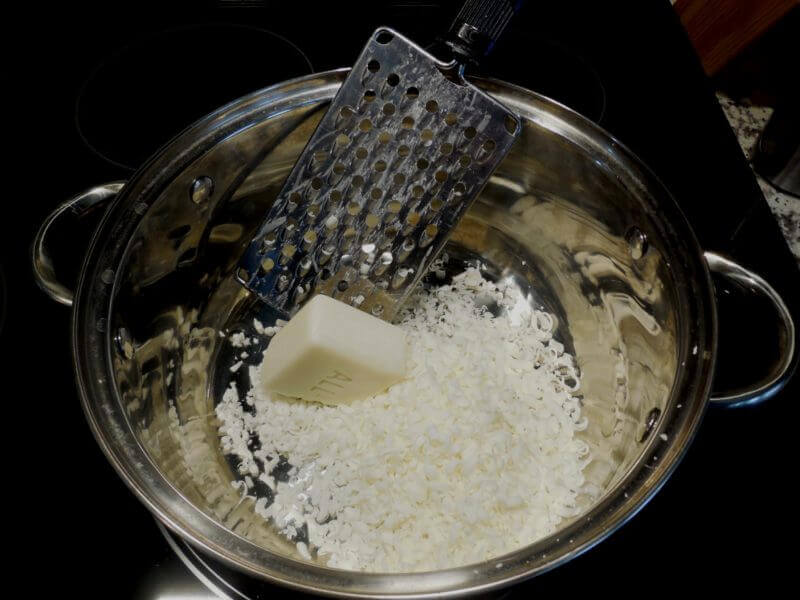
Begin on your stovetop, grating half the bar of soap in a LARGE pot on low heat. Emphasis on the LARGE. You will see why in Step 4.
Step 2: Add Water
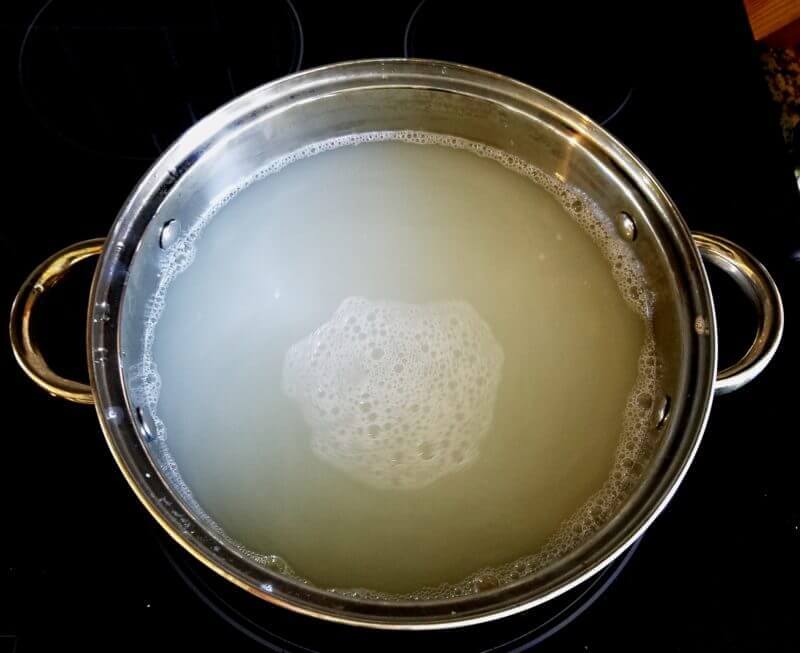
Slowly add 5 cups of water. Stir until the soap is completely dissolved. You should see just a few suds at this point.
Step 3: Add Dry Ingredients
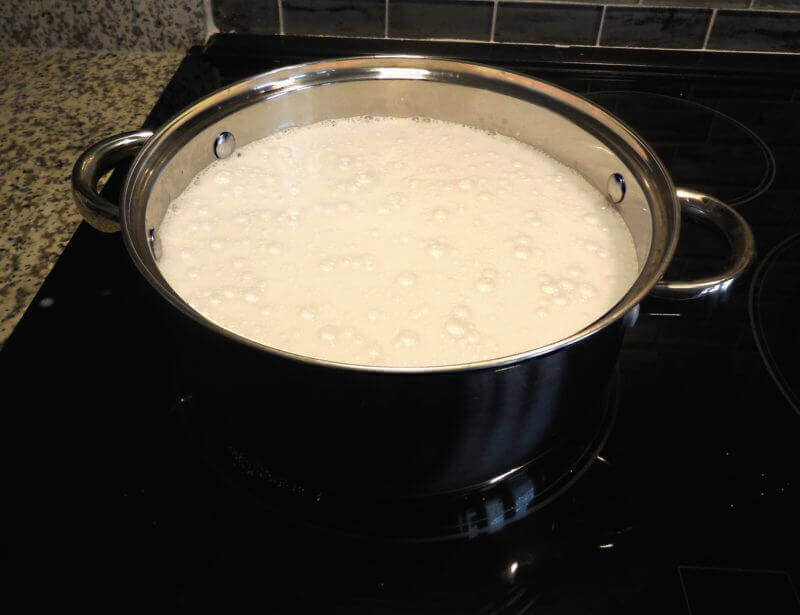
Stir OxyBoost and Washing Soda gently into the mixture until dissolved. This will take 2-3 minutes, and the mixture will start to feel frothy and begin to grow.
Now the growing part is the fun part. The kids may want to watch, but keep little ones safely back from the stove. This is a hot, alkaline cleaning mixture, and the dry powders can irritate eyes and skin.
Step 4: Remove From Heat
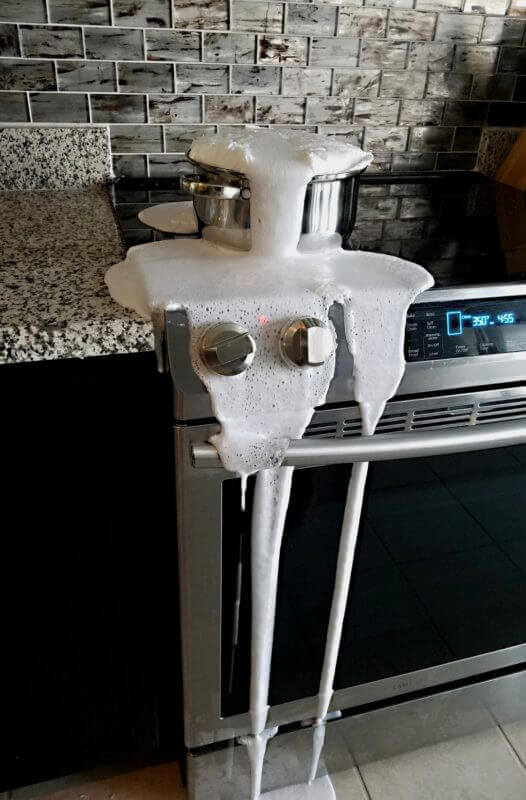
Before it begins to overflow, remove from heat, and move to a sink to catch suds overflow. I didn’t do this step the first time, and the kiddos made a slip and slide on my tile floors in the kitchen. Watch the blob grow if desired, and let cool.
Use oven mitts and move the pot carefully. Soap on tile can become extremely slippery, and a pot full of hot cleaning solution is not something you want splashing.
Step 5: Add Water to Jars
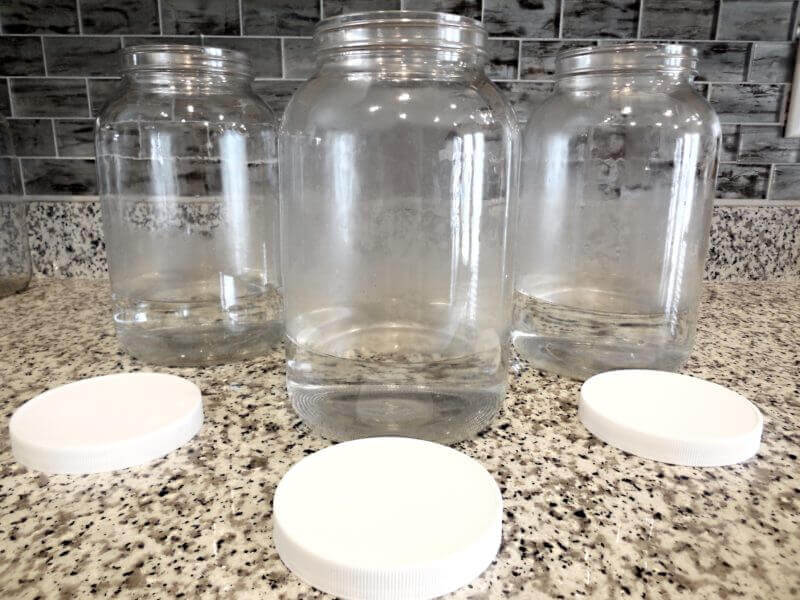
Once the soap has cooled for about 10 minutes, add 4 cups of HOT water to each jar.
Use clean, heat-safe glass containers and add hot water carefully. Avoid pouring very hot water into a cold or damaged jar because sudden temperature changes can crack glass.
Step 6: Add Essential Oils
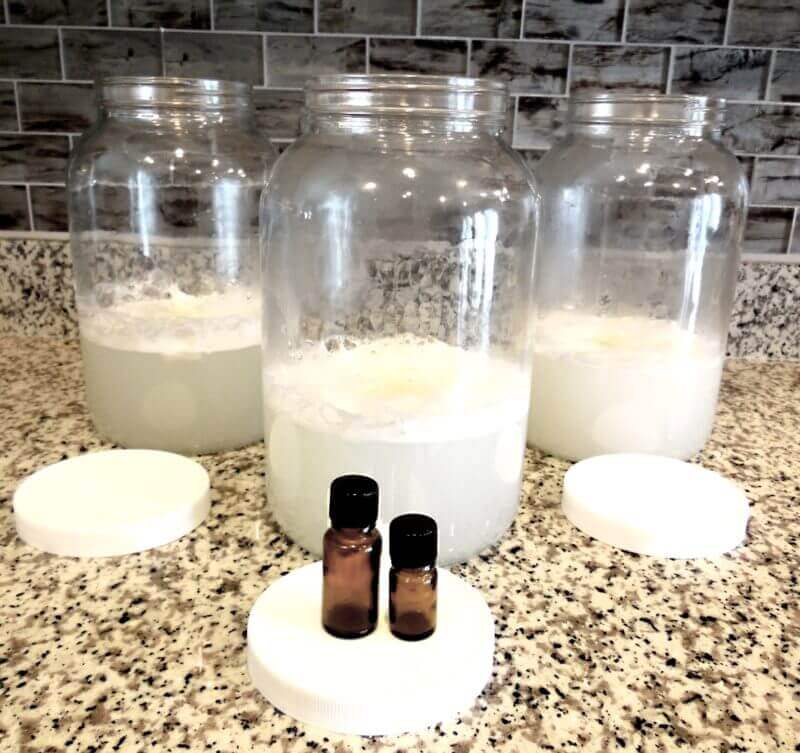
Evenly distribute the soap mixture and 40 drops of your favorite citrus oil to each jar.
Step 7: Let Mixture Thicken
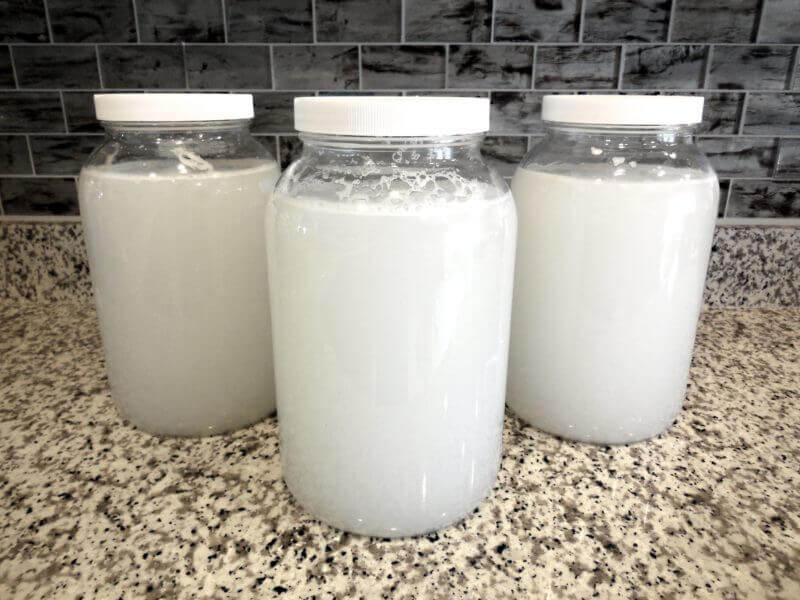
Stir the mixture and add cool water to fill each jar till almost full. Let set overnight to thicken some.
It’s a good idea to clean your washing machine from time to time. Most of us don’t do it often enough. Thankfully TrulyFree has made a Washing Machine Cleaner you can use to help remove the buildup and grime that can make a washer smell less than fresh.
Homemade Laundry Soap Safety & Washer Tips
This is a family-friendly DIY, but it is still a cleaning product. A few simple habits make a big difference.
- Keep dry powders out of the air. Pour washing soda and OxyBoost gently and avoid breathing dust. Both sodium carbonate and sodium percarbonate can irritate the eyes and respiratory tract. (5, 6)
- Protect children during preparation. Let them enjoy watching from a safe distance, but an adult should handle the stove, hot solution, powders, and jars.
- Do not experiment with cleaner combinations. Do not add chlorine bleach, ammonia, acids, or other laundry chemicals to this homemade mixture unless a product label specifically says the combination is compatible.
- Follow garment-care labels. Oxygen bleach, alkaline boosters, hot water, and essential oils are not appropriate for every delicate, specialty, or dry-clean-only fabric.
- Follow your washer manual. High-efficiency washers are designed for low-sudsing HE detergents. Major washer manufacturers warn that using a non-HE product can lead to excess suds, poor rinsing, longer cycles, or other performance problems. This homemade formula is not manufacturer-certified as HE detergent, so follow the requirements for your specific machine. (8)
- Watch for residue or buildup. Water hardness, load size, washer type, detergent amount, and rinse performance can all affect how a soap-based formula behaves. If clothes or the washer begin to develop residue, clean the machine and reassess what your washer needs.
Homemade Laundry Soap FAQs
Is homemade laundry soap the same as laundry detergent?
Not technically. Soap is traditionally made by reacting fats or oils with an alkali, while modern detergents usually use manufactured surfactants designed for specific water conditions and washing machines. This homemade recipe uses Castile soap as the cleaning base plus washing soda and oxygen bleach as laundry boosters, which is why people commonly call it homemade laundry detergent.
Does homemade laundry soap really clean clothes?
Yes, a soap-and-booster formula can clean many everyday washable loads when it is used in a compatible washing machine and water system. Results can vary with water hardness, soil level, fabric type, load size, water temperature, and rinsing.
Why use washing soda in homemade laundry soap?
Washing soda, or sodium carbonate, raises the alkalinity of the wash and helps loosen greasy soils. It is a useful laundry builder, but the concentrated powder can irritate eyes, skin, and airways, so handle it carefully. (5)
What does OxyBoost do in this recipe?
OxyBoost provides oxygen-based bleaching and stain-removal support. Its sodium-percarbonate cleaning chemistry releases hydrogen-peroxide-based oxidizing action when mixed with water, while sodium carbonate adds alkalinity. (6, 7)
What essential oils are used in this laundry soap?
Our recipe uses citrus essential oil, specifically lemon, orange, or grapefruit. Follow the recipe amount rather than adding extra oil for a stronger scent.
Is homemade laundry soap good for sensitive skin?
Some families prefer a short ingredient list and unscented Castile soap when skin is sensitive, but no laundry formula is universally irritation-free. Fragrance and essential oils can be contact allergens for some people. If you or your child has eczema, fragrance allergy, or unexplained clothing-pattern irritation, consider professional guidance and a completely fragrance-free laundry routine. (3)
Can I use this homemade laundry soap in an HE washing machine?
Check your owner’s manual first. HE washers are engineered for low-sudsing, quick-dispersing detergents labeled for HE use, and manufacturers warn that non-HE products can interfere with rinsing and washer performance. This homemade recipe has not been certified by your washer manufacturer as an HE detergent. (8)
Why does homemade laundry soap get thick or lumpy?
Soap-based homemade detergents can thicken or gel as they cool. That is normal for this recipe. Follow the instructions in the preserved recipe block for stirring and use.
Do fragranced laundry products cause cancer?
It is not accurate to say that using a fragranced laundry detergent has been proven to cause cancer. Research has identified VOC emissions from specific fragranced laundry products, including compounds classified as carcinogenic hazardous air pollutants. Those studies measured emissions, not cancer outcomes in product users. Our approach is to reduce avoidable fragrance exposure without turning preliminary or exposure research into a disease promise. (1, 2)
What is the easiest way to detox a laundry room?
Start with the products you use most often. Replace heavily fragranced detergent, fabric softener, dryer sheets, and stain products with simpler options one at a time. Homemade laundry soap is one practical place to begin because you know exactly what you put into it.


References
- Steinemann AC. “Fragranced Consumer Products and Undisclosed Ingredients.” Environmental Impact Assessment Review. 2009;29(1):32-38. doi:10.1016/j.eiar.2008.05.002.
- Steinemann AC, Gallagher LG, Davis A, MacGregor I. “Chemical Emissions From Residential Dryer Vents During Use of Fragranced Laundry Products.” Air Quality, Atmosphere & Health. 2013;6(1):151-156. doi:10.1007/s11869-011-0156-1.
- Bai H, Tam I, Yu J. “Contact Allergens in Top-Selling Textile-Care Products.” Dermatitis. 2020;31(1):53-58. PubMed.
- U.S. Environmental Protection Agency. “Volatile Organic Compounds’ Impact on Indoor Air Quality.” Updated June 23, 2026. EPA.
- National Library of Medicine. “Sodium Carbonate.” PubChem. Accessed August 18, 2026. PubChem.
- National Library of Medicine. “Sodium Percarbonate.” PubChem. Accessed August 18, 2026. PubChem.
- Truly Free Home. “OxyBoost.” Accessed August 18, 2026. Product information.
- Maytag. “What Is HE Detergent and Why Should I Use It?” Accessed August 18, 2026. Maytag.